Threads, fasteners and gears
Part scripts can import two build123d part libraries besides build123d itself. Both are installed with b123d-print and work inside the sandbox:
| Library | For | Import |
|---|---|---|
| bd_warehouse 0.4.0 | threads (ISO, trapezoidal, Acme, Whitworth, plastic bottle), screws, nuts, washers, heat-set inserts, clearance and tap holes, bearings, gears and worms, sprockets, pipes, flanges, O-rings, OpenBuilds V-slot parts | from bd_warehouse.thread import IsoThread, PlasticBottleThreadfrom bd_warehouse.fastener import SocketHeadCapScrew, HexNut, HeatSetNutfrom bd_warehouse.open_builds import VSlotLinearRail, TNut |
| py_gearworks 0.0.24 | involute spur, helical, herringbone, bevel, ring and cycloid gears and racks, with meshing (mesh_to), profile shift and backlash |
import py_gearworks as gw |
These libraries model the standard parts. Whether a part prints is a separate question, and the rest of this page covers it. The AI follows the same rules (the workflow rules, "Threads, fasteners and gears").
Why bd_vslot is not included
bd_vslot 0.0.2 (MIT) fails to build its rails with
build123d 0.13, the version b123d-print pins: every rail opens an empty location list,
which 0.13 refuses. bd_warehouse.open_builds has the same 2020 rail and T-nut, so use that.
Threads: model them, or not?
Model a thread when it is M6 or larger with a coarse pitch, or a bottle or jar thread. Two sources put the floor at M6 JLC Sovol, and Hubs at M5 (BP-T1). Below M5 the crests and roots are close to one extrusion line wide SOVOL-THR. Bigger and coarser is easier: M8 and up prints comfortably. Sovol recommends 2–4 mm pitches with rounded roots for custom threads, and a layer height of at most 1/6–1/8 of the pitch SOVOL-THR.
- Print the thread axis upright (Z) SOVOL-THR. Each turn is then traced in the layers; lying on its side, a thread turns into stair steps and sagging roofs.
- Expect an overhang warning on a 60° thread. Its flanks are 30° from horizontal, so the
downward flank is 60° from vertical, past the 45° limit. Snapmaker calls these flanks
"difficult to print accurately as overhangs" SNAP-THR. For an M10 × 1.5,
checkreports each turn's underside at 60°. Each flank is short, so a coarse thread still works, but its underside comes out rough, and this is why fine threads print poorly. A buttress profile has a 45° flank and a flat one. With the 45° flank facing down it has no overhang at all, as in the bottle thread below. - Clearance: about 0.1–0.2 mm per side (0.2–0.4 mm on the diameter) to start
SOVOL-THR. Use your measured sliding fit (
load_settings(__file__).clearance, see Settings) and print a test pair. bd_warehouse threads take it asmanufacturing_compensation, which is radial: it moves an internal thread outward and an external one inward by that much. - Ends: fade or chamfer the start, so the first turn is not a blunt sliver that catches
and breaks. Sovol suggests a 0.8–1.5 mm chamfer at the entry SOVOL-THR.
bd_warehouse:
IsoThread(..., end_finishes=("fade", "chamfer")). Bottle threads always fade both ends. - Walls: 3–5 perimeters around a thread SOVOL-THR. Under constant tension PLA creeps and loosens.
from bd_warehouse.thread import IsoThread
from b123d_print import load_settings

CLEARANCE = load_settings(__file__).clearance  # per side
# an M10 x 1.5 external thread, 12 mm long, both ends faded, standing on Z
thread = IsoThread(major_diameter=10, pitch=1.5, length=12, external=True,
                   end_finishes=("fade", "fade"), manufacturing_compensation=CLEARANCE)
Bottle and jar threads are coarse (4–8 threads per inch) and short, which makes them easy
to print. A finish such as 38-400 names a neck about 38 mm across and a thread style. The
400 finish has about one turn, 410 one and a half, 415 two REGENT. bd_warehouse
covers ASTM D2911 ("M38SP400": M for the buttress profile of plastic closures, L for the
trapezoidal profile of metal closures) and PCO-1881 (soda bottles, "28" with
bottle_type="pco1881"). PlasticBottleThread.identify(...) finds the finish from measurements
taken off a bottle. Measure the diameter over the thread crests (T) and the neck between the
threads (E) BERLIN.
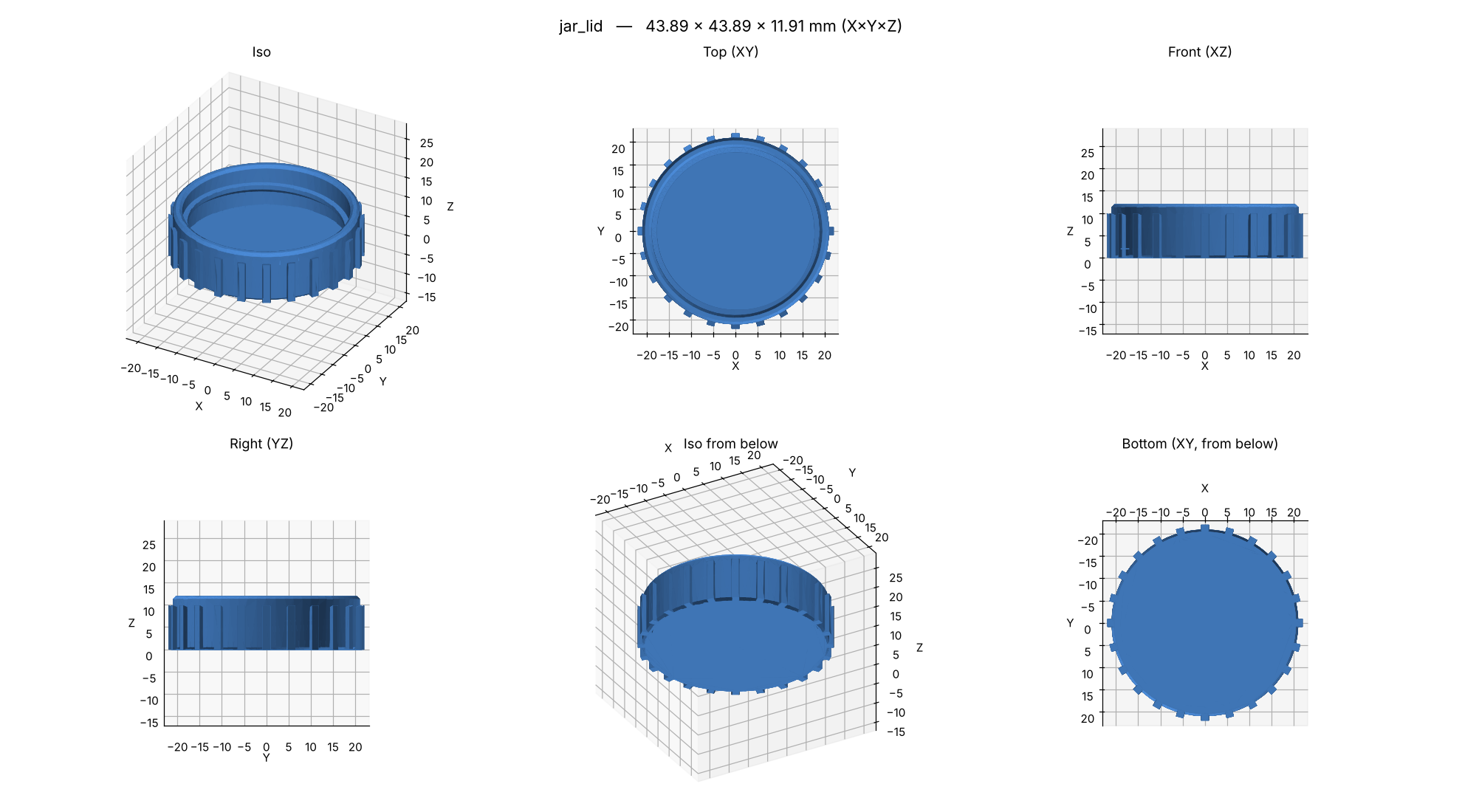
The jar_lid example: an internal 38-400 thread, top of
the cap on the bed.
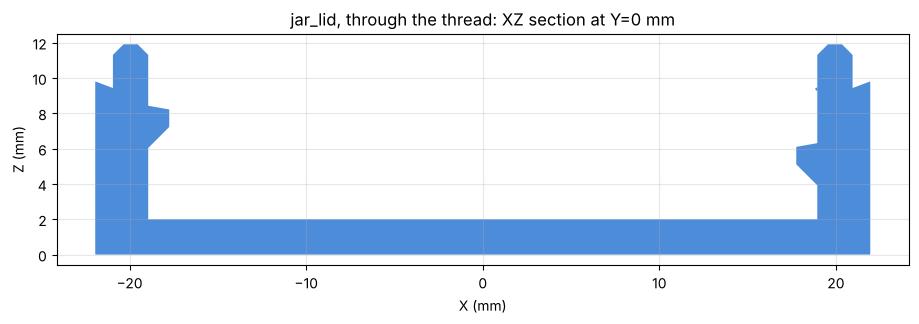
In print orientation the steep (45°) flank of the buttress faces down and the flat one faces up, so the thread prints without supports.
Small threads: inserts, nuts, self-tapping
Below about M6, don't model the thread BP-T1. Use one of these:
- Heat-set inserts for anything opened more than a few times. A screw driven straight into
plastic holds about as well in pull-out, but strips at about 1 Nm, against 3 Nm for an
insert CNCK-HELI. Use the insert maker's hole size plus
HOLE_COMP(CNC Kitchen: M3 × 5.7 → 4.0 mm, M4 × 8.1 → 5.6 mm, M5 × 9.5 → 6.4 mm) CNCK-TABLE. Make the hole straight and blind, about 1 mm deeper than the insert, with no chamfer needed CNCK-TIPS. Keep at least the maker's minimum wall around it (M3 1.6, M4 2.1, M5 2.6 mm) CNCK-TABLE, and install at print temperature + 10–20 °C CNCK-TIPS. - Captive nuts: a hex pocket across-flats + 0.2 mm in total (BP-T7). A pocket that opens downward can print over a one-layer sacrificial bridge.
- Self-tapping screws into a pilot hole: M3 ≈ 2.6–2.9 mm, depending on material and orientation. Print a test pair (BP-T6).
bd_warehouse holes and hole compensation
bd_warehouse has the fastener tables, so take sizes from them instead of typing them in:
from bd_warehouse.fastener import HeatSetNut, SocketHeadCapScrew

screw = SocketHeadCapScrew("M4-0.7", 16)
screw.clearance_hole_diameters   # {'Close': 4.3, 'Normal': 4.5, 'Loose': 4.8}
screw.tap_hole_diameters         # {'Soft': 3.3, 'Hard': 3.5}  (for a tap, not a self-tapping screw)
screw.head_diameter, screw.head_height
insert = HeatSetNut("M4-0.7-8.1", "CNCKitchen")   # also "ruthex", "McMaster-Carr", ...
insert.nut_data["m"], insert.nut_data["material_thickness"]   # 8.1 long, 2.1 minimum wall
Its hole objects (ClearanceHole, TapHole, ThreadedHole, InsertHole) cut a hole in
place. Mind how they meet hole compensation, so a hole is compensated
once:
| Hole | Compensation | Do this |
|---|---|---|
ClearanceHole(screw, fit=...), TapHole(screw, ...) |
none; cut at the table's nominal size | read the size from screw.clearance_hole_diameters[fit] and cut it yourself with + HOLE_COMP, like every other hole (the insert_bracket example does this) |
InsertHole(insert, manufacturing_compensation=...) |
radial, added to the radius | pass HOLE_COMP / 2 (HOLE_COMP is on the diameter). It cuts the table's drill size, which can differ from the maker's hole: 5.79 mm for the CNC Kitchen M4 against the maker's 5.6. Where that matters, cut the maker's size yourself |
PlasticBottleThread, IsoThread, ... manufacturing_compensation |
radial | your clearance per side (above). It is a fit, not hole compensation: don't add HOLE_COMP as well |
Don't also turn on the slicer's hole compensation.
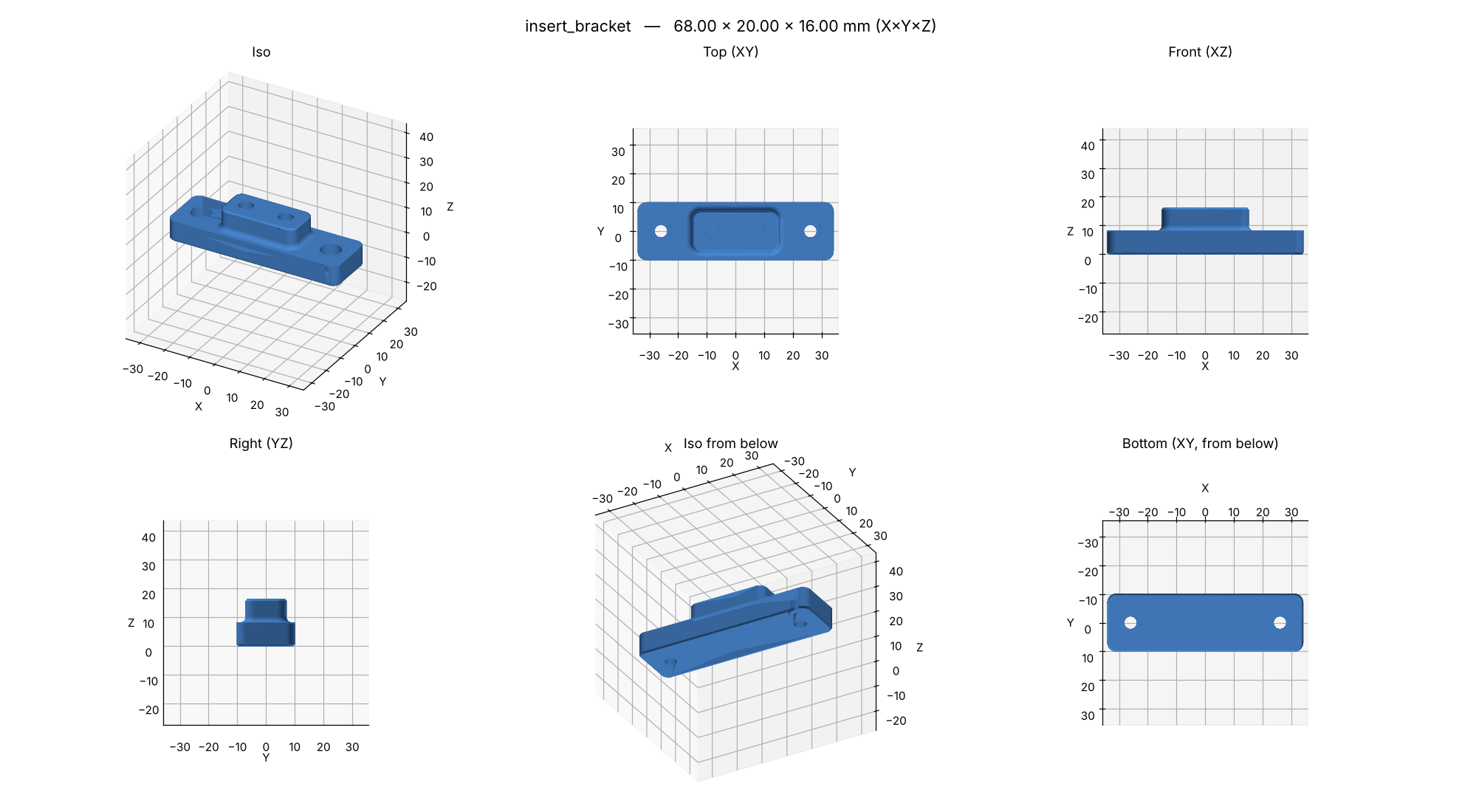
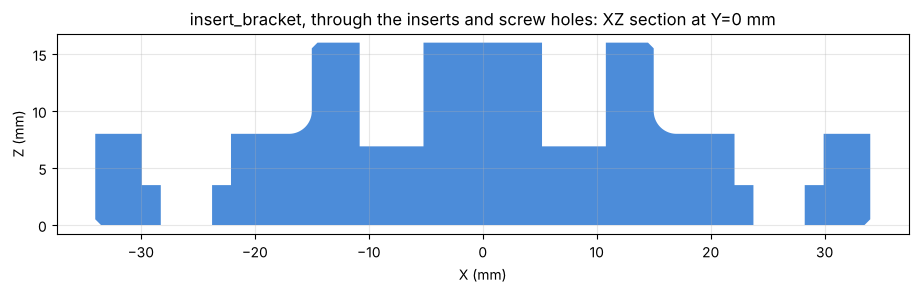
The insert_bracket example: two CNC Kitchen M4
inserts in blind 5.6 mm holes on top, and two counterbored M4 clearance holes sized from
bd_warehouse.
Gears
- Module ≥ 1, preferably 1.5–2 for a 0.4 mm nozzle. Module 1 suits light duty only, and below 1 the teeth are a few lines wide SOVOL-GEAR. Bigger modules are stronger HTM.
- Face width about 10 × module GS-FW, or 3–5 circular pitches SOVOL-GEAR (about 9–16 × module).
- Backlash: printed gears need more than metal ones KHK-PLASTIC. Thin each gear's flanks by
0.1–0.2 mm, for 0.2–0.4 mm in total SOVOL-GEAR. py_gearworks:
backlash=on each gear is a coefficient of the module along the line of action (0.1 at module 1.5 is 0.15 mm), andmesh_tosets the center distance to suit. Add aGapcheck between the meshed gears inassembly(d)to see what is left. - Few teeth: at a 20° pressure angle a gear with fewer than 17 teeth is undercut at the root.
A positive profile shift avoids that KHK-INV:
profile_shift=(17 - z) / 17in py_gearworks, which moves the center distance (mesh_toaccounts for it). - Helical and herringbone gears run smoother and quieter and carry more load. A herringbone's
two halves cancel each other's axial thrust TEC-HB. They are harder to line up
SOVOL-GEAR. A herringbone must be meshed before it goes onto its shafts HTM.
py_gearworks:
HelicalGear(..., helix_angle=..., herringbone=True). - Print flat on the bed for the most accurate tooth profile. Standing on edge, the flanks come out rough and the bore needs support SOVOL-GEAR. 4–6 walls make the teeth solid perimeters. Chamfer only the bore's top edge: a chamfer at the bed widens the hole downward, which is an overhang.
- Material: PLA is stiff and strong but softens at 55–60 °C. PETG gives (75–80 °C) instead of snapping. ASA is 95–100 °C SOVOL-GEAR. Plastic gears change size with temperature and moisture and lose strength as they warm KHK-PLASTIC. Industrial plastic gears are nylon or acetal (POM).
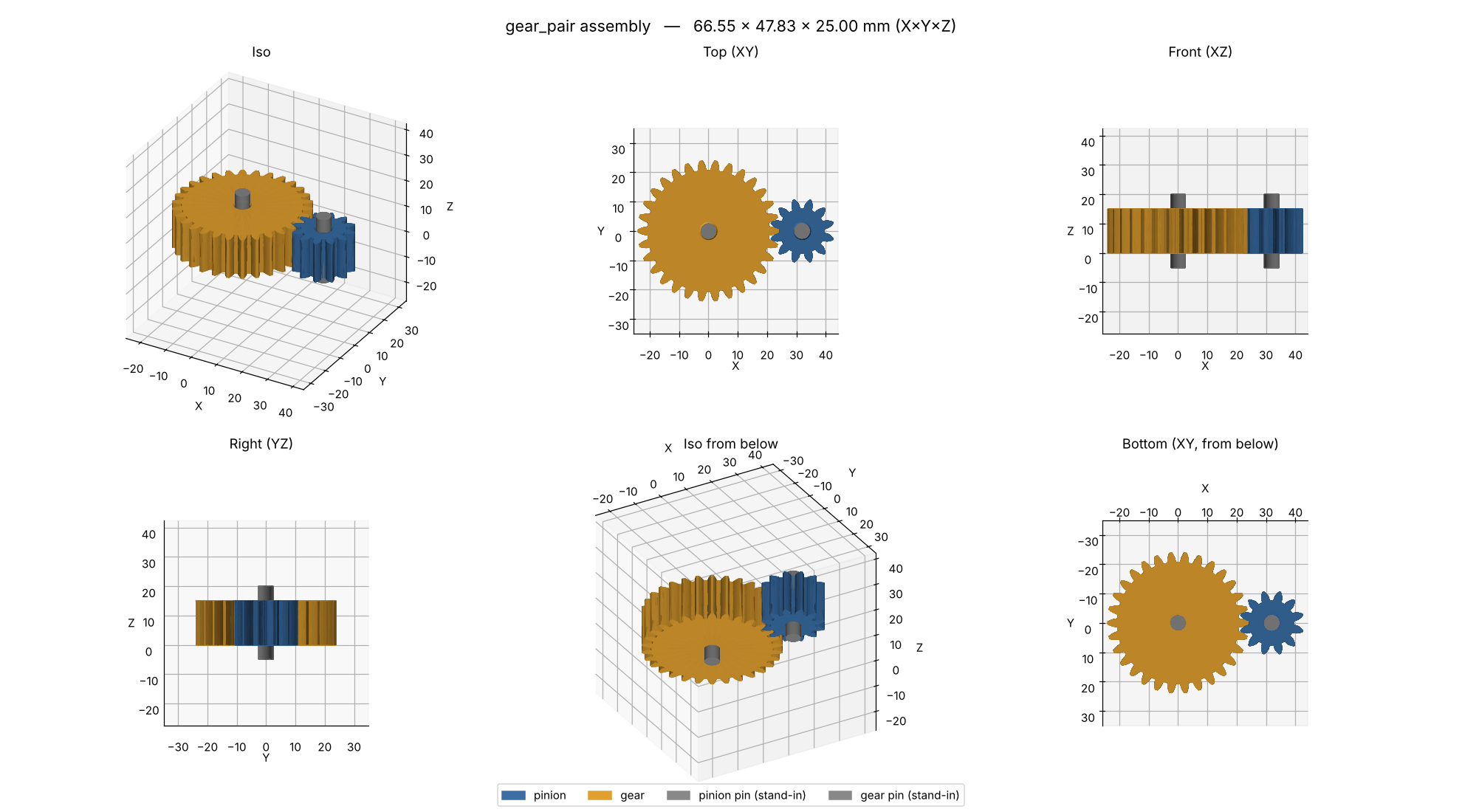
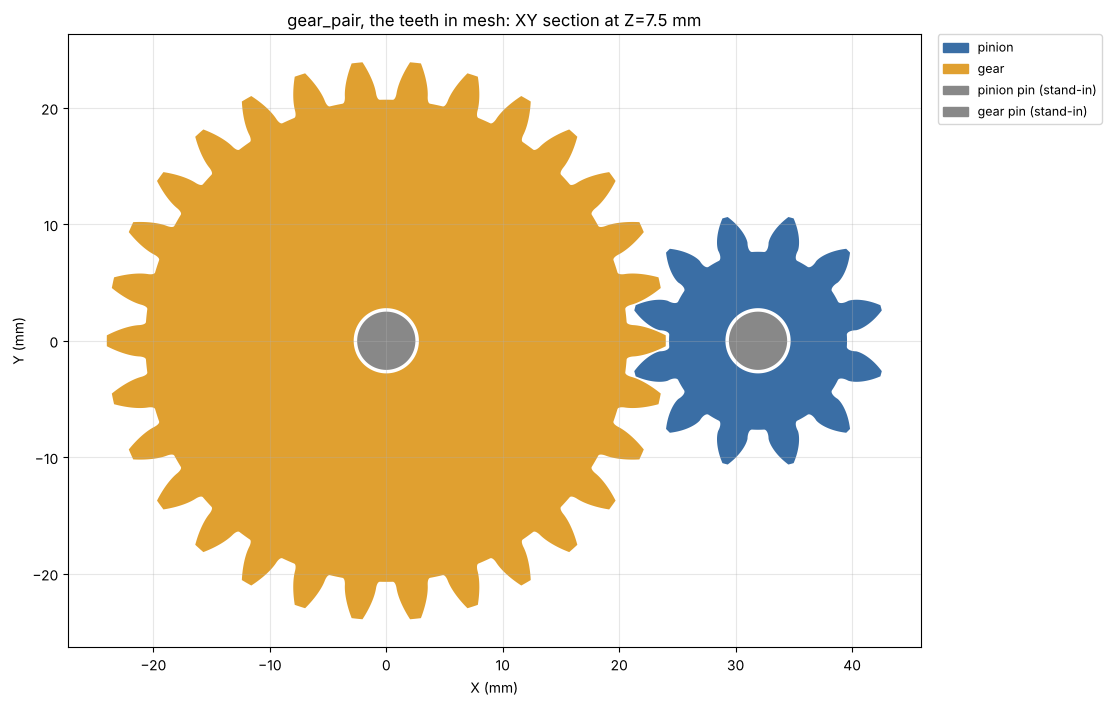
The gear_pair example: a 12-tooth pinion with profile
shift and a 30-tooth gear, module 1.5, with 0.15 mm between the teeth.
bd_warehouse also has SpurGear, HelicalGear, RackGear and a worm drive (Worm,
WormWheel). py_gearworks has no worms.
2020 V-slot extrusion
- The slot: 6 mm across the opening, an M5 tapped bore in the middle (4.2 mm drilled) SYSTEAL. On V-slot the slot opens into a 45° V groove at the face. Suppliers differ in detail (some bores are 5 or 6 mm), so measure yours.
- Fasteners: M5 screws into T-nuts. A drop-in or sliding T-nut has a narrow neck that sits in the lips' opening and a flange under the lips. Screw length = plate + a few mm into the nut, short of the slot's floor. M5 × 8 is the common pairing for a 3–4 mm plate (retailer and forum advice, not fetched).
- Locating: a key that drops into the slot keeps a bracket square to the rail. Shape it as a
V with 45° sides to match the groove: it centers itself, and it prints without support
with its sides facing up. The T-nut's neck fills the slot about 1 mm below the face, so the key
can only be shallow. Use your sliding fit (
clearance) normal to the flanks; there is no published value for this. - Stand-ins: put the rail and the T-nuts in
assembly(d)frombd_warehouse.open_builds(VSlotLinearRail("20x20", length),TNut()turned across the slot), and the overlap andGapchecks prove the key fits.
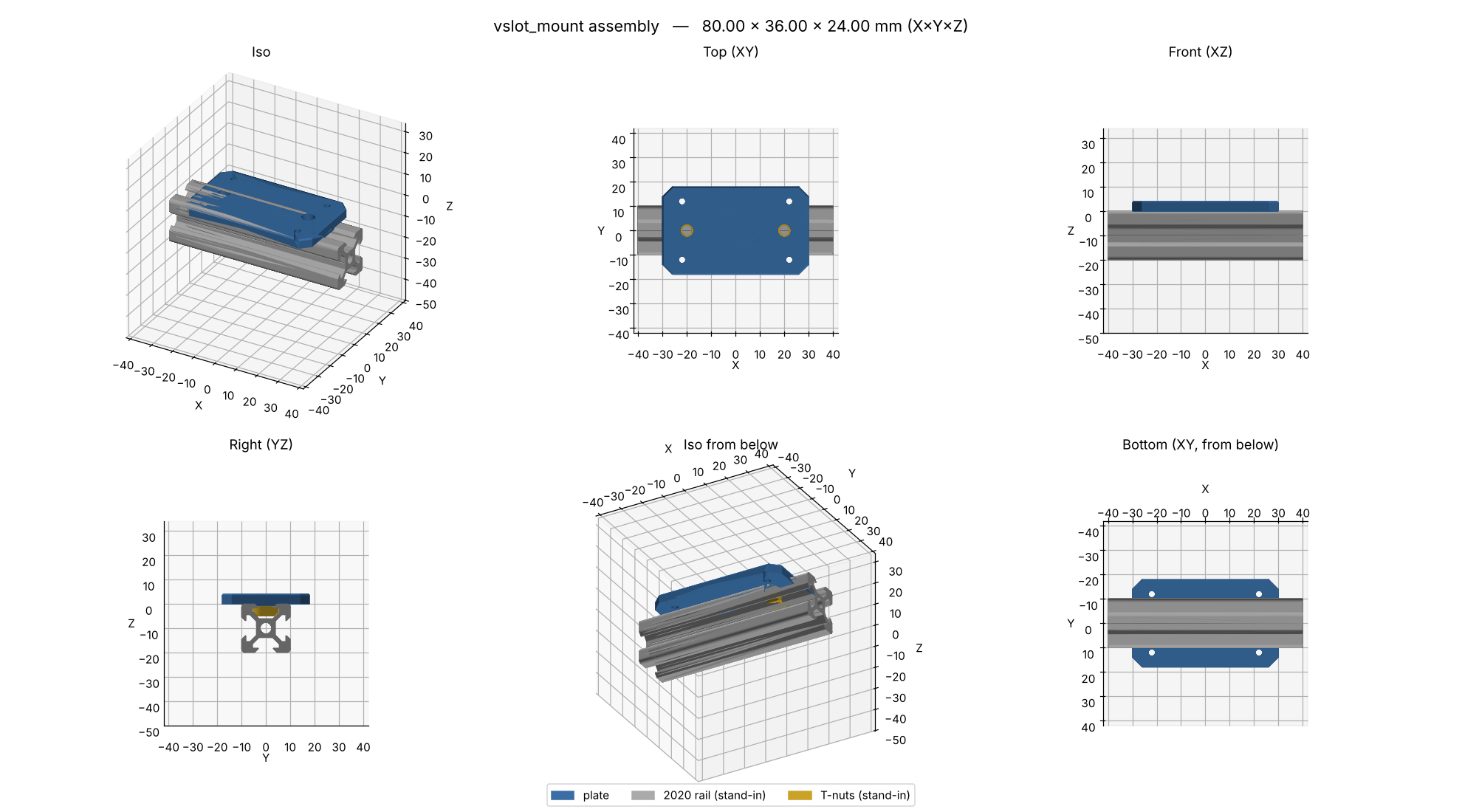
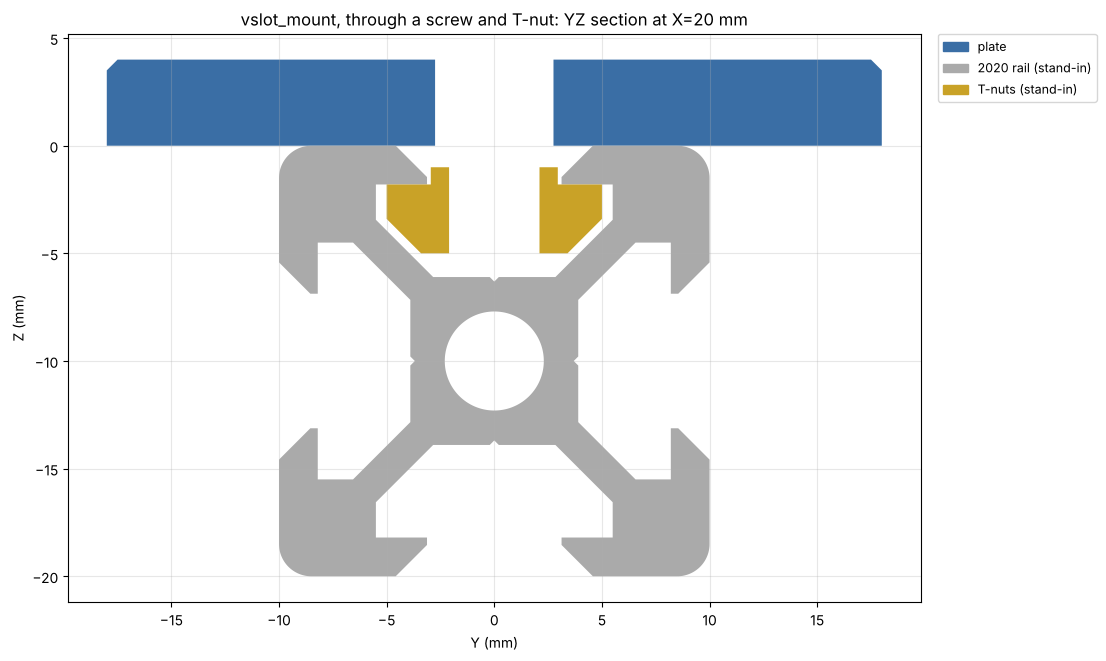
The vslot_mount example: a V key 0.2 mm off the
groove's flanks and 0.3 mm above the T-nut's neck.
Sources
Fetched in October 2026 unless marked. Values from a single vendor blog (Sovol) are starting points: print a test.
| Claim | Source |
|---|---|
| Smallest modeled thread M6 | JLC3DP, 3D printing design guideline |
| M6+ for a 0.4 mm nozzle; pitch ≥ 1 mm, custom 2–4 mm; layer ≤ pitch/6–1/8; 0.10–0.20 mm radial clearance; vertical axis; 0.8–1.5 mm entry chamfer; 3–5 walls; PLA creep | Sovol, 3D printing threads and screws (vendor blog) |
| Threads standing up; chamfer as a guide; 60° flanks hard as overhangs | Snapmaker, 3D printing threads |
| 38-400: neck diameter and finish; 400 one turn, 410 one and a half, 415 two | Regent Plast, neck finishes; Pretium, Neck know-how |
| T, E, H, S finish dimensions | Berlin Packaging, Neck finish guide |
| Direct screw ~1 Nm, insert 3 Nm (PETG, M3) | CNC Kitchen, Helicoils, inserts and nuts in 3D prints |
| Insert holes and minimum walls (M3 4.0/1.6, M4 5.6/2.1, M5 6.4/2.6) | CNC Kitchen datasheet, as copied by 3DJake (the CNC Kitchen store returned HTTP 429) |
| Blind hole ~1 mm deeper; straight; no chamfer needed; iron at print temperature + 10–20 °C | CNC Kitchen, Tips and tricks for heat-set inserts |
| Insert at print temperature + 10 °C | Prusa, Heat-set inserts M3 |
| Module 1.5–2 for 0.4 mm, 1 the lower limit; backlash 0.1–0.2 mm per gear; face 3–5 circular pitches; print flat; materials | Sovol, 3D printing gears that actually work (vendor blog) |
| Bigger module stronger; helical smoother; herringbone meshed before mounting | How To Mechatronics, How to 3D print gears |
| Face width 10 × module | Gear Solutions, Face width in gear design |
| Undercut below 17 teeth at 20°; positive profile shift | KHK, Involute gear profile; Gear Solutions (KHK USA), Addendum modification and undercut |
| Plastic gears: more backlash; thermal and moisture change; nylon and acetal | KHK, Design of plastic gears |
| Herringbone halves cancel axial thrust; more load, less noise | tec-science, Herringbone gears |
| V-slot 2020: 6 mm slot, 4.2 mm bore for M5 | Systeal, V-slot 20×20; Electrokit, V-slot 2020 |
| M5 × 8 for a 3 mm plate on T-nuts | Makerstore, Screw guide (not fetched: HTTP 403) |